
By Doug Spencer-Roy, EastLink Corporate Affairs & Marketing Manager
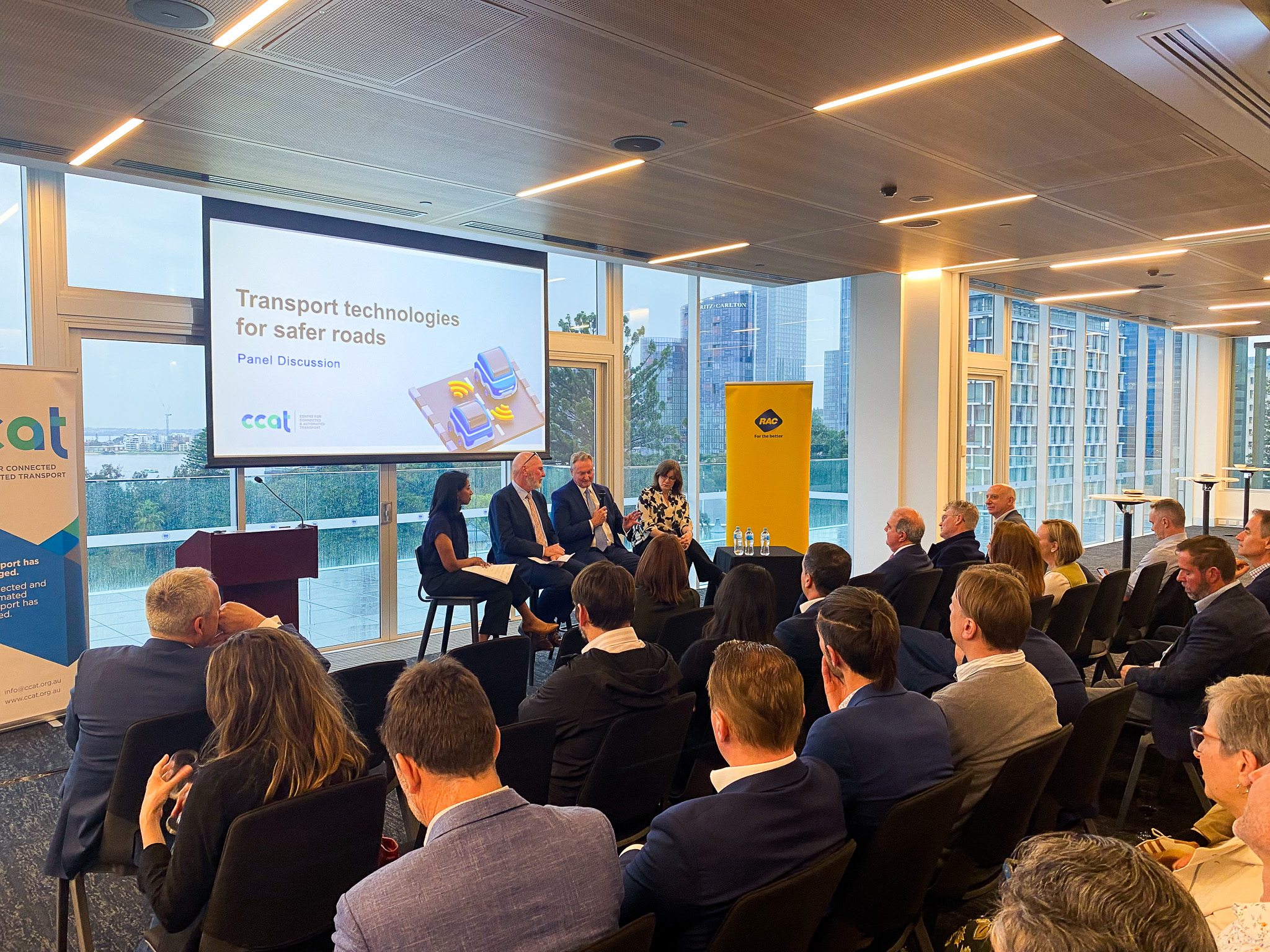
In September 2025, CCAT’s National Future Transport Summit brought together Australia’s leading transport innovators, policymakers, and industry stakeholders to shape the future of mobility.
With automation and self-driving technologies advancing rapidly, the Summit’s Safety theme – sponsored by EastLink – was central to discussions, reflecting a shared commitment to achieving zero deaths and serious injuries across all transport modes.
The Safety theme was more than a topic; it was a call to action. While participants debated and agreed on 14 Summit recommendations to maximize the benefits of connected and automated transport, the three Safety themed recommendations stood out as key pillars for the industry’s future direction:
These three recommendations recognise that the promise of automation must be matched by rigorous safety standards, transparent communication, and data-driven policy-making.
By prioritizing safety, leveraging advanced data, and fostering a coordinated national approach to innovation and testing, stakeholders can develop policies, standards, and infrastructure that support the safe integration of self-driving technologies.
Immediately following the Summit and building on the momentum, EastLink conducted its annual Self-Driving & Electric Car Survey in October/November 2025, with more than 5,700 Victorian motorists responding. This timing provided a unique opportunity to capture motorists’ attitudes in the wake of national conversations about the future of transport.
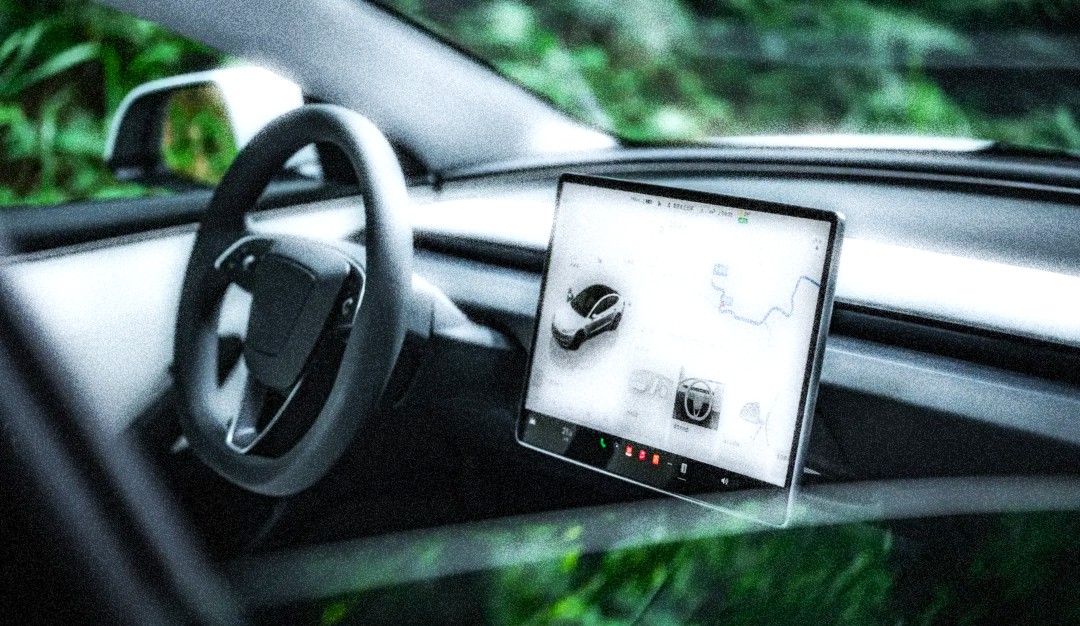
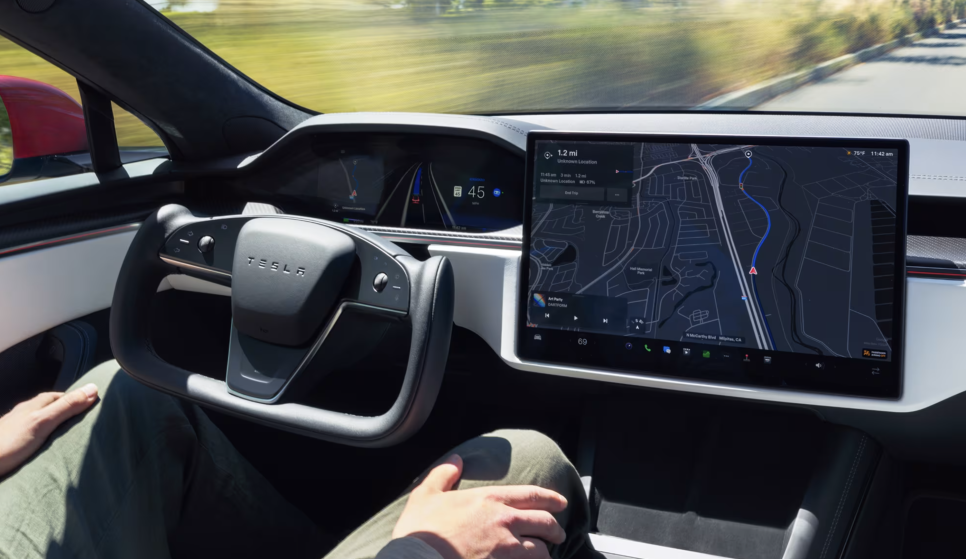
A pivotal development also occurred just prior to the survey period: the activation of Tesla Full Self-Driving (Supervised) in Australia during September 2025. This milestone brought advanced automated driving capabilities to a wider audience and had a direct impact on motorists’ experiences and perceptions. The survey results show that the increase in the proportion of respondents who have been driven in a fully self-driving vehicle – from 3.5% in 2023 to 7.4% in 2025 – is largely attributed to the launch of Tesla’s Full Self-Driving (Supervised). This feature is enabling more and more Australians to experience self-driving technology first hand, shaping their attitudes and expectations.
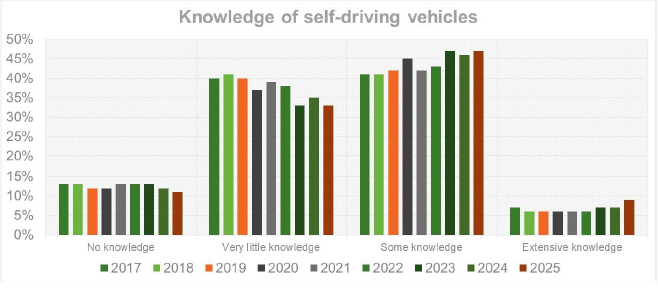
Since 2017, there has been a steady shift in motorists’ perceptions of their knowledge about self-driving cars. A record 9% of respondents now consider themselves to have “extensive
knowledge,” up from 6% in previous years, while those with “no knowledge” or “very little knowledge” have dropped from 54% to a record low of 47%.
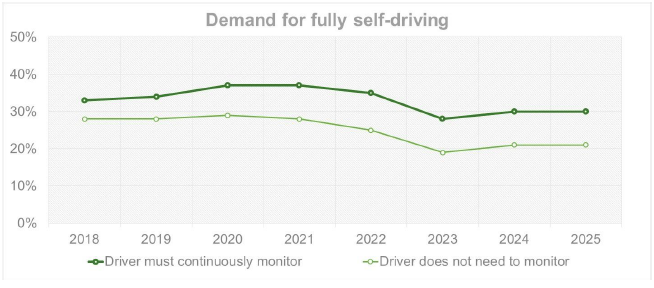
This growing familiarity is mirrored by a gradual increase in trust: 17% of respondents now score their trust in self-driving technology highly (8–10 out of 10), up from 12% in 2023. However, scepticism is changing less quickly, with 34% scoring their trust at the lowest levels (0–2 out of 10), down from 37% in 2023.
Safety is the dominant theme in motorists’ attitudes toward automation. The majority of survey respondents express concerns about the ability of self-driving vehicles to protect drivers, passengers, pedestrians, and cyclists. Key questions include:
Many respondents also express distrust in the technology, citing fears of software bugs, hacking, and the inability of AI to make complex ethical decisions in emergencies.
The survey highlights widespread uncertainty about the legal status of self-driving vehicles in Australia, especially in Victoria. Respondents want clarity on who is responsible in the event of an accident—driver, manufacturer, or software provider—and how insurance works for self-driving vehicles. Questions about government oversight, certification, and the process for approving self-driving vehicles for public use are common.
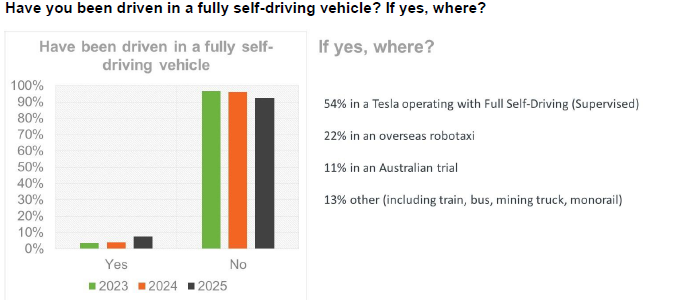
While only 7.4% of respondents have been driven in a fully self-driving vehicle, their experiences are mixed. Positive reactions include feelings of safety, excitement, and relaxation, while negative reactions centre on discomfort, anxiety, and a lack of trust. Many note that repeated exposure increases comfort, but persistent doubts remain, especially in complex urban environments.
Tesla’s Full Self-Driving (Supervised) will continue to play a major role in further expanding real-world experience with automation among Australian motorists.
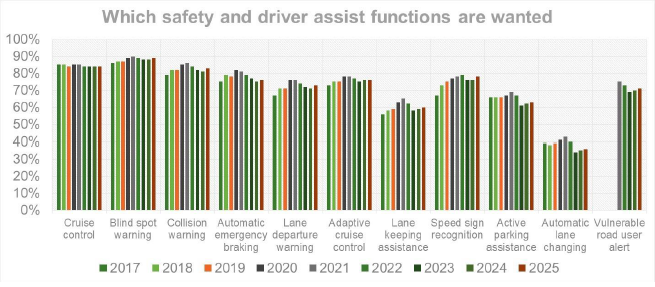
Driver assist functions are increasingly used, but motorists remain wary of features that take over steering, such as automatic lane changing and active parking assistance. The desirability of most driver assist functions has increased slightly over the past year or two, but the three least wanted features are those involving steering.
Notably, 2% of respondents are already using Tesla Full Self-Driving (Supervised), while just over 5% own a Tesla – a significant achievement given the recent launch of its availability in Australia. This rapid uptake demonstrates strong interest and early adoption among Tesla owners, and highlights the impact of new technology on real-world experience and attitudes.
The journey toward mainstream adoption of self-driving vehicles will depend on addressing practical barriers, building public trust, and demonstrating real-world benefits. The survey underscores the importance of transparent communication, robust regulatory frameworks, and continued innovation. As more Australians gain experience with self-driving technologies, and as industry and government work together to prioritize safety, harness data, and foster a coordinated innovation ecosystem, the vision of zero deaths and serious injuries on our transport networks becomes increasingly attainable.
The Summit’s focus on safety, data-driven policy-making, and national coordination sets a clear direction for the future. By embracing these principles, stakeholders can ensure that automation delivers on its promise of safer, more efficient, and more accessible transport for all.
Download the full survey results here


We’re here to help. If you’d like to learn more about CCAT, explore partnership or membership opportunities, or simply have a question about our work, we’d be happy to hear from you. Reach out to connect with our team and discover how you can be part of shaping the future of transport in Australia and New Zealand.