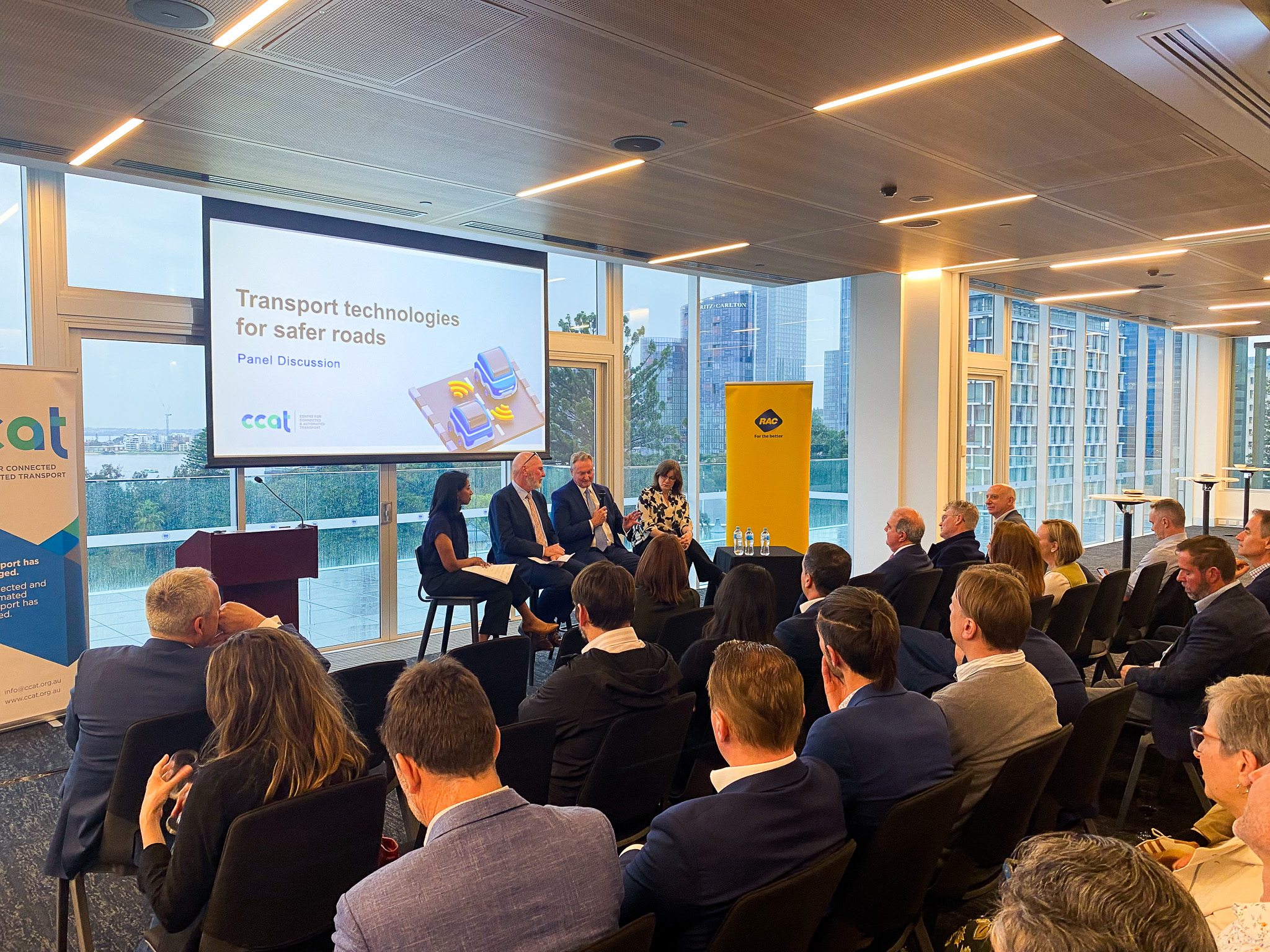
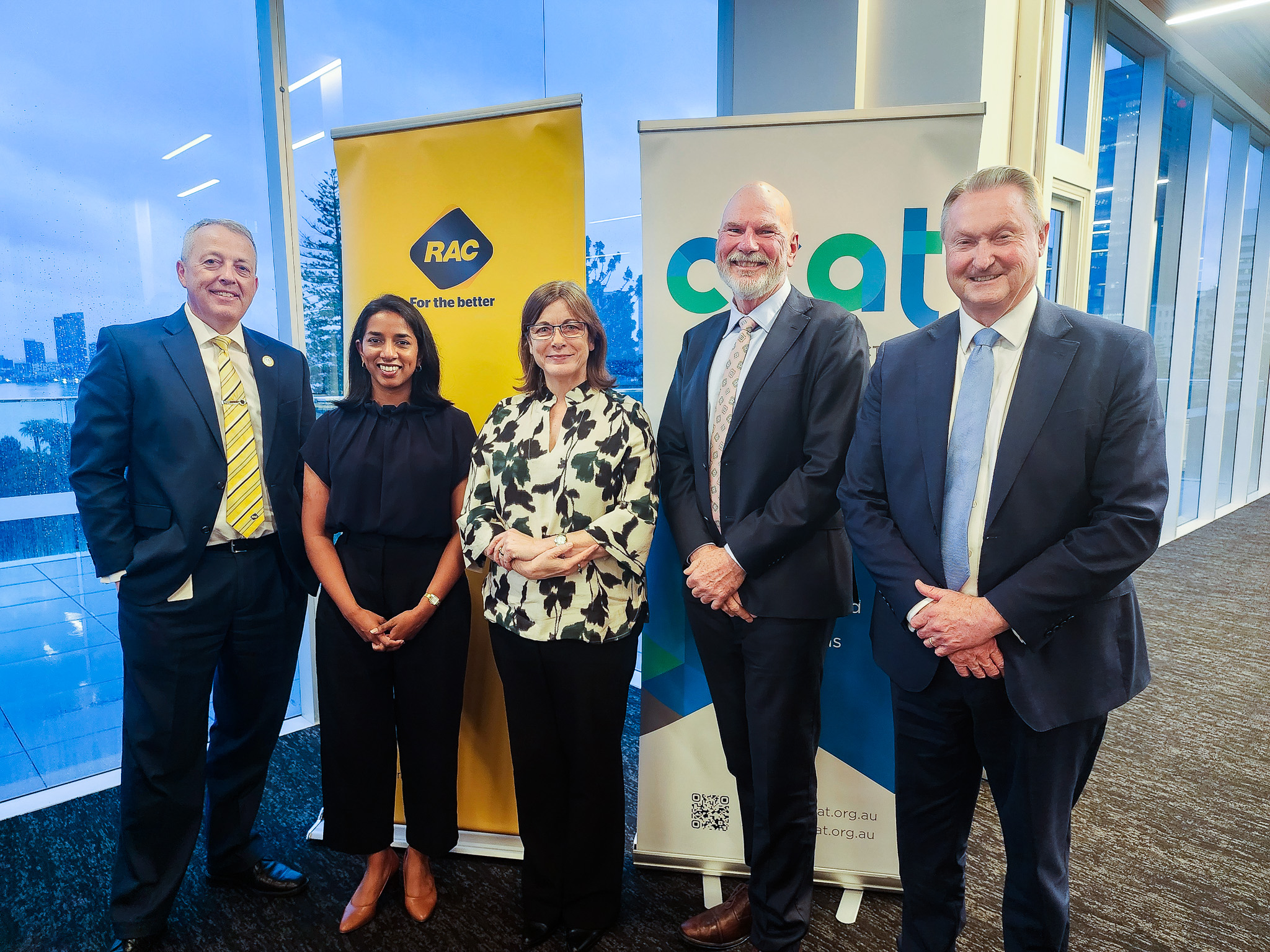
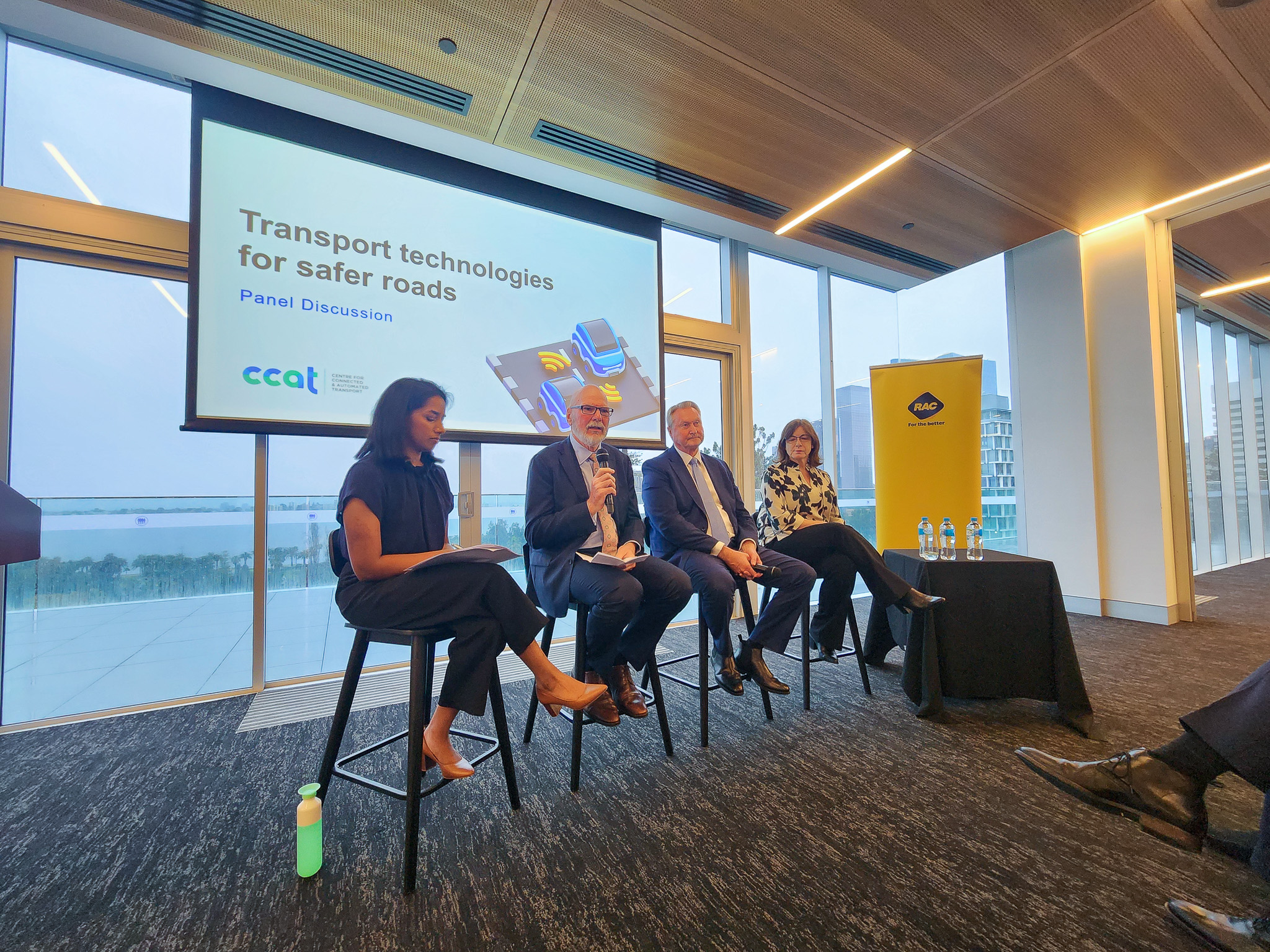
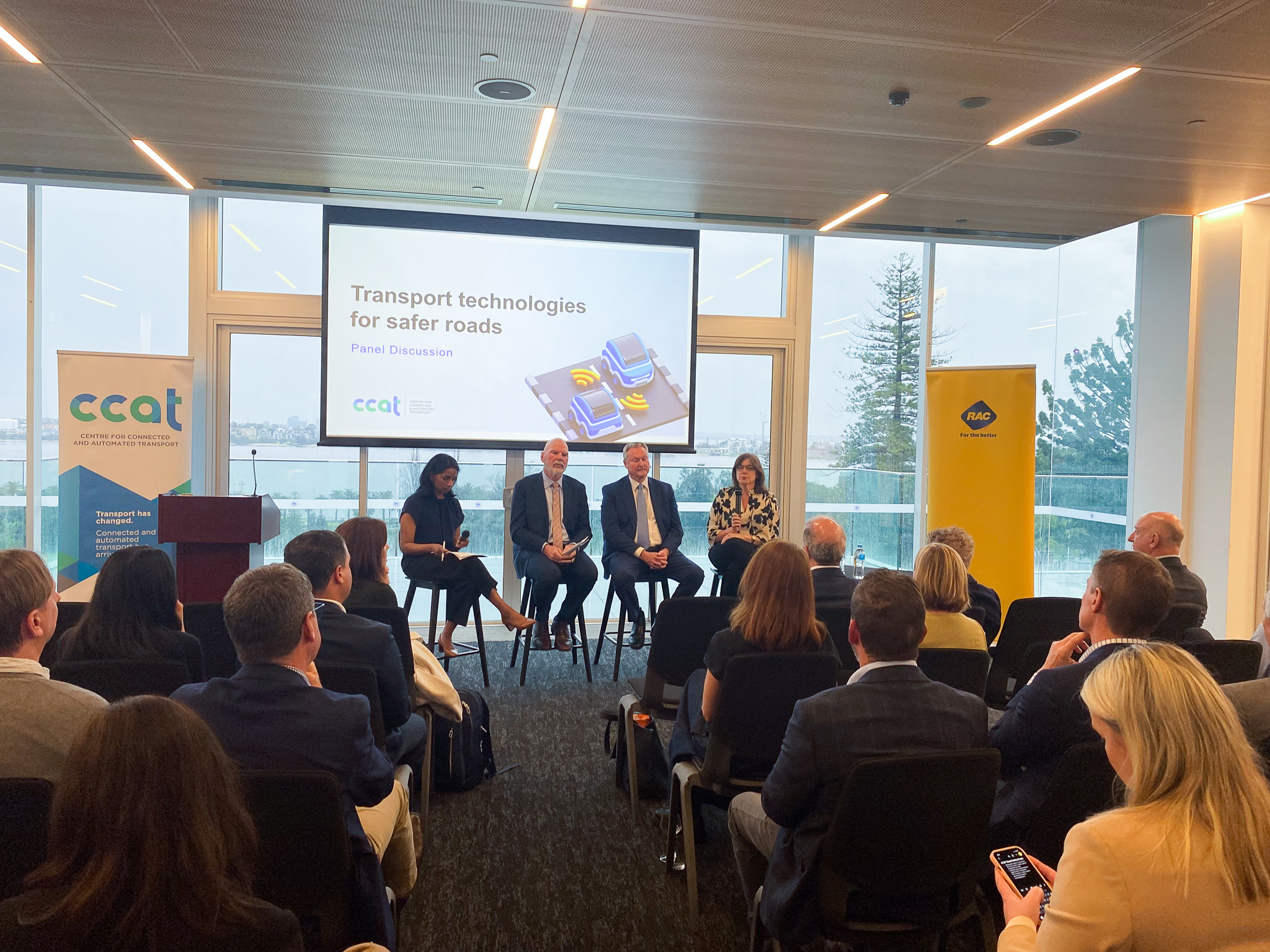
On 26 August 2026, the Centre for Connected and Automated Transport (CCAT) hosted a stakeholder event in Perth exploring how transport technologies can help address Australia's ongoing road safety challenge. The discussion built on themes raised at CCAT's 2025 National Future Transport Summit, which identified advanced road technologies as a priority for accelerating progress toward eliminating deaths and serious injuries across transport networks. CCAT’s Executive Director, Rahila David opened the event and moderated an panel discussion featuring Department of Transport and Major Infrastructure Director General Peter Woronzow, WA Road Safety Commissioner Adrian Warner, and Director of the WA Centre for Road Safety Research (UWA) Teresa Senserrick, following a welcome address from RAC WA Group CEO and Executive Director Rob Slocombe.
Setting the scene
In his opening address, Rob Slocombe framed road trauma as the biggest challenge facing the WA community. As of mid-August 2026, 146 people had lost their lives on WA roads this year, the highest year-to-date toll in at least a decade, putting the state on track to pass 200 road deaths in a year for the first time since 2008. Against that backdrop, Rob set out a vision of a safer, more sustainable and better-connected transport future for all Western Australians and cautioned that public confidence in new technologies must be earned, not assumed. He posed an important question: will these technologies genuinely improve people's lives, or simply shift the risks around?
Widening the ‘safe system’ lens
Professor Teresa Senserrick urged attendees to think across all elements of the safe system, and to bring a more nuanced understanding of road user behaviour into that thinking, including considering how unexpected or atypical behaviours might interact with road design and technology. She pointed to the concept of ‘motonormativity’; the tendency to treat driving as an unremarkable, ‘default’ activity despite it being one of the highest-risk things most people do, as a useful frame for the sector.
Local and regional leadership
Peter Woronzow pointed to work already underway to make the state road network safer in rural areas, with the Department now partnering with the local government network to extend similar safety improvements to roads under council control. He argued that technology should ultimately be judged by whether it delivers better outcomes for the people behind the wheel.
Rebalancing streets around people
Adrian Warner turned attention to pedestrian-dense areas of the CBD, noting that decades of planning have prioritised vehicle movement over the safety and experience of people on foot. Intersection risk, he noted, is an increasingly complex problem, and advanced camera systems combined with machine learning could likely outperform human monitoring in identifying near-misses and hazards before they become fatalities.
Bringing the public along
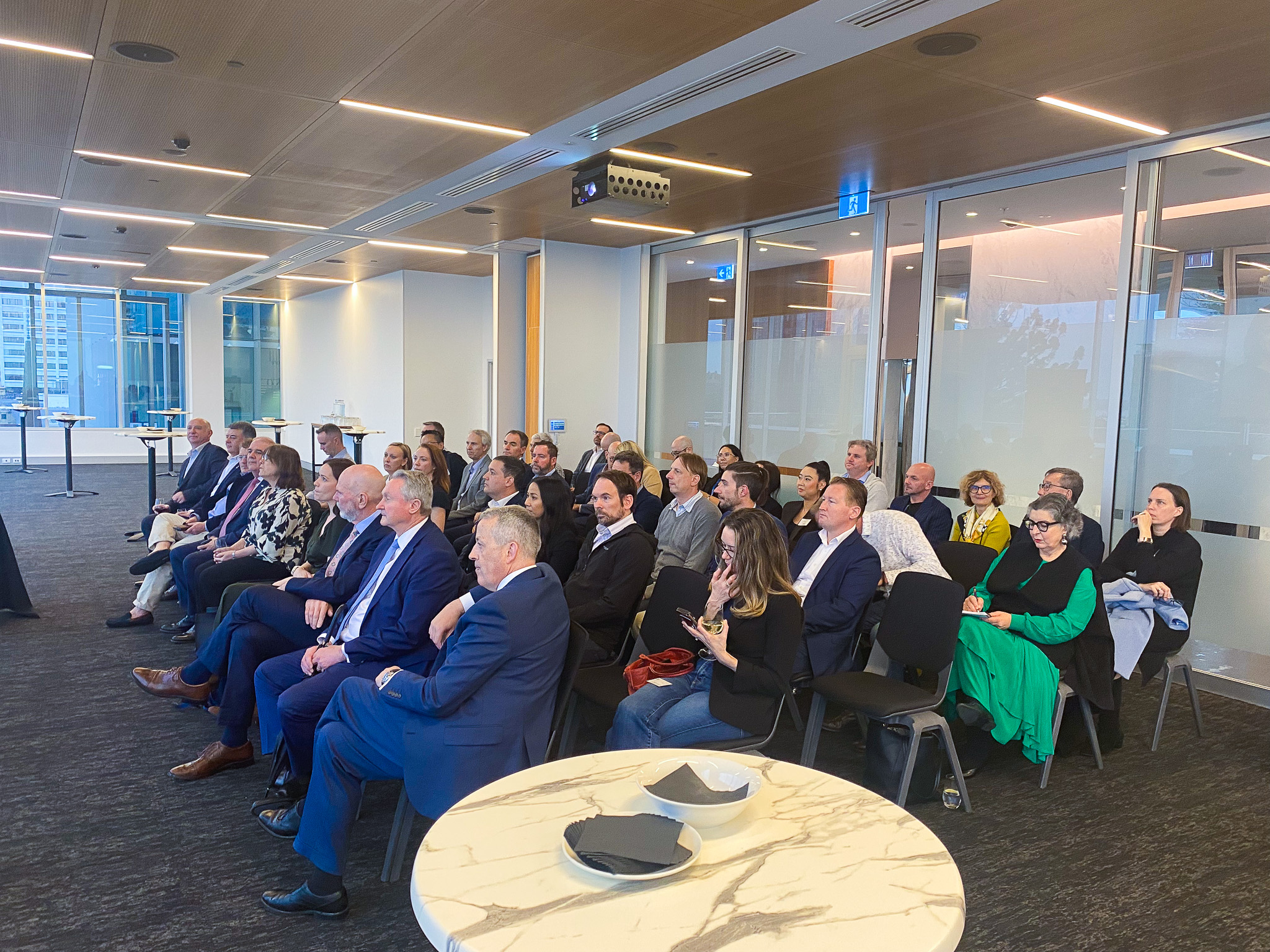
Across the panel, there was broad agreement that resistance to change is real, but that leading with truth and evidence, rather than assumption, is essential for getting communities on board with transport technologies and road safety strategies. Speakers pointed to mode-shift as an important part of the solution: driving slower, and driving less, with more deliberate prioritisation of people's movement outside of vehicles. As one reference point, it took roughly four years for e-mobility to be recognised as a genuine safety issue at national level - a reminder that shifting public and institutional attitudes takes sustained effort.
The panel pointed back to RAC's Intellibus trial as proof this kind of demonstration works: the shuttle bus trial ran successfully across several WA locations, with the community responding positively to both the technology and its safety, and to the role it played in supporting public transport more broadly. The catch, panellists noted, is that the trial ended almost a decade ago, and WA hasn't seen a comparable public demonstration of automated vehicle technology since, reinforcing the panel's call to pick specific places and demonstrate value there again.
Where to start: heavy vehicles and regional Australia
Discussion turned to where automated vehicle technology could and should be trialled first. Rather than starting in central Perth, panellists noted a regional focus would give rural and remote communities the chance to benefit from technology already operating in their backyard (particularly in the case where they are in close proximity to agriculture and mining operations). Heavy vehicles were repeatedly raised as the area most likely to advance quickly, and planning was identified as a lever CCAT and its network can use to enable this.
Audience questions: regulation and the road toll
During audience questions, discussion turned to whether current regulators are the right bodies to set the rules for these emerging technologies. Heavy vehicles were suggested as a more straightforward starting point for reform than other use cases. The panel was asked to share their perspectives on data and trends relating to the road toll, highlighting pedestrians and motorcyclists as the categories seeing the biggest increases. This fed into a broader conversation about scaling enforcement: a one-size-fits-all approach isn't working, and better data is needed to target interventions where they'll have the most impact.
What’s next?
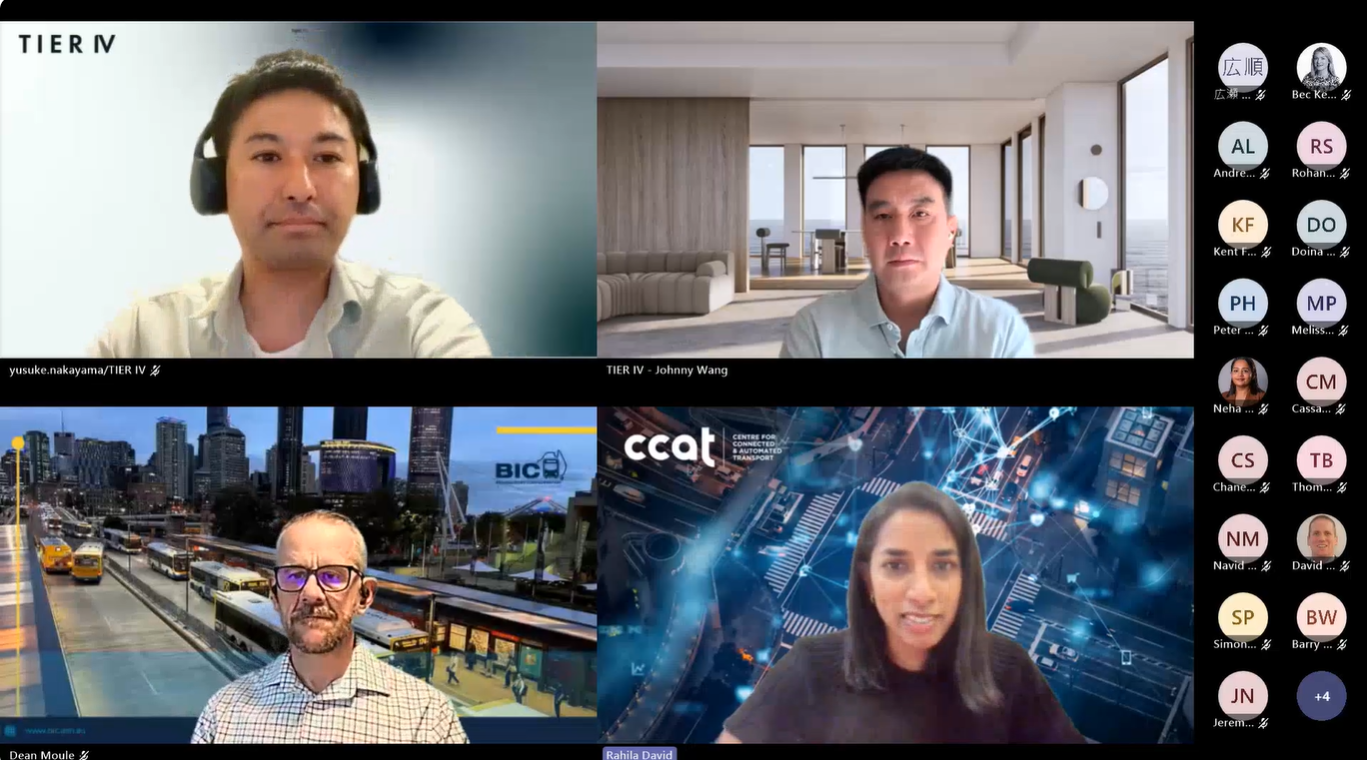
Rahila David closed the event by reflecting on the discussion and introducing CCAT International, CCAT's upcoming digital conference series connecting Australian decision-makers with international connected and automated transport technology providers. In order for Australia to harness the road safety benefits of these technologies, it is vital that we have an up-to-date view of emerging technology and international implementation approaches.
The event highlighted that WA’s road safety challenge is immediate and worsening, and that technology alone won't solve it. Speakers were clear that public confidence has to be built deliberately, that the safe system must account for real human behaviour and diversity, and that the fastest wins may lie in regional and heavy vehicle applications rather than metropolitan automated vehicle deployment.
CCAT would like to thank RAC WA for their support for this event, and to our panel and guests for sharing their valuable insights.


We’re here to help. If you’d like to learn more about CCAT, explore partnership or membership opportunities, or simply have a question about our work, we’d be happy to hear from you. Reach out to connect with our team and discover how you can be part of shaping the future of transport in Australia and New Zealand.