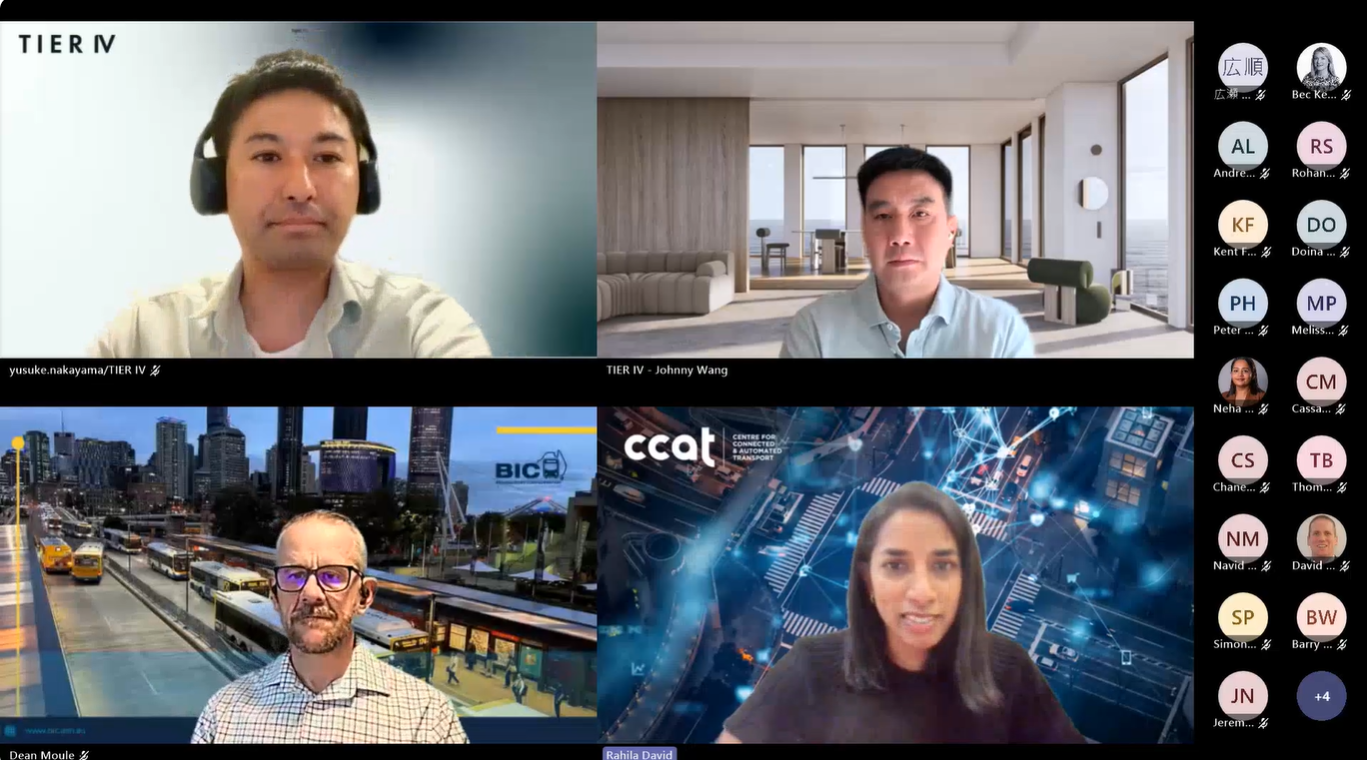
On 29 September, CCAT hosted an online webinar with TIER IV and the Bus Industry Confederation (BIC) to explore what it will take to bring autonomous bus trials to Australia. Moderated by CCAT Executive Director Rahila David, the session featured a presentation from TIER IV, an overview of Australia's automated vehicle landscape, and a panel discussion examining the opportunities and challenges associated with autonomous bus deployment.
The webinar opened with a presentation from Yusuke Nakayama, Department Manager for Global Projects at TIER IV, a Japanese deep-tech company dedicated to accelerating the deployment of autonomous vehicles through its open-source software platform, Autoware.
TIER IV positions itself as a technology platform company. It works in partnership with vehicle manufacturers, transport operators and local governments to deploy autonomous solutions tailored to community and operational needs.
Yusuke highlighted four key applications currently being developed and deployed by TIER IV:
A key theme of the presentation was the role of government-industry collaboration in enabling deployment. TIER IV has worked closely with Japanese government agencies over the past decade, helping to inform safety requirements, operational standards and legislative frameworks through real-world trial experience.
Japan's autonomous vehicle journey has evolved through three distinct phases: an initial trial and innovation phase supported by regulatory sandboxes, a period focused on developing legal and operational frameworks, and the current transition towards large-scale deployment. Japan is now targeting up to 10,000 autonomous vehicles operating on public roads by 2030.
Yusuke noted that many of the factors driving adoption in Japan are also relevant in Australia, including workforce shortages, road safety objectives and the need to decarbonise transport networks. As a result, Australia has become an important strategic market for TIER IV's future expansion plans.
Rahila David provided attendees with an overview of Australia's progress in connected and automated transport.
Automated vehicle trials have now been undertaken in every Australian state and territory, ranging from low-speed passenger shuttles to freight vehicles and delivery robots. While large-scale commercial deployment has not yet commenced on public roads, Australia has established considerable experience in trials and operational testing. At the same time, highly automated systems have already become commonplace in sectors such as mining and agriculture.
Rahila also outlined current regulatory developments. Automated vehicle trials presently operate under state and territory approval frameworks, while a national automated vehicle program is progressing the development of a new legislative framework for commercial deployment.
The presentation also explored the broader ecosystem supporting automated transport in Australia. Governments, local councils, universities, insurers, operators and technology providers have all played an important role in trial programs to date, while local capability in in-vehicle technologies and aftermarket integration continues to grow.
However, several challenges remain. Workforce transition, cybersecurity and privacy concerns, community acceptance and the future design of transport networks will all need to be addressed as automated technologies move towards wider deployment.
A central message of the presentation was that technology readiness alone does not guarantee deployment success. Regulatory readiness, organisational capability and community confidence are equally important components of Australia's automated transport future.
Johnny Wang, Head of Business Development (APAC) at TIER IV, and Dean Moule, National Technical Manager at the Bus Industry Confederation joined Rahila for an interactive panel discussion examining the practical realities of autonomous bus deployment.
One of the most significant themes was the growing challenge of driver shortages. Panellists highlighted that Japan has experienced the cancellation of thousands of kilometres of bus services due to workforce constraints, with similar pressures emerging across Australia. Rather than replacing drivers entirely, speakers suggested that automation is likely to change the nature of transport jobs, creating new roles in remote supervision, fleet management and passenger assistance.
Safety was another key focus. Panellists discussed the potential for autonomous systems to reduce risks associated with driver fatigue while providing additional layers of detection and protection for vulnerable road users. Current TIER IV deployments include multiple redundant systems and fail-safe capabilities designed to safely stop vehicles in the event of a fault.
The discussion also explored the ingredients required for a successful trial. Participants emphasised the importance of bringing together technology providers, vehicle manufacturers, governments and transport operators from the outset. Operators, in particular, need to be engaged early to understand how autonomous services will affect day-to-day operations, depot management, vehicle charging and remote monitoring requirements.
Community acceptance was identified as another critical factor. Experience from previous Australian shuttle trials has shown that public scepticism often decreases once passengers have experienced the technology firsthand. Panellists noted that bus trials offer a particularly valuable opportunity to build public familiarity with automated transport because they can expose large numbers of people to the technology in a safe and controlled environment.
The session concluded with discussion of potential trial locations and future opportunities. Interest continues to grow among metropolitan and regional communities across Australia, with councils, operators and industry partners increasingly exploring how new transport technologies could support local transport needs.
As momentum continues to build, TIER IV is seeking partners interested in participating in future automated bus trials. The webinar demonstrated that while technical capability is advancing rapidly, success will ultimately depend on partnerships, collaboration and a shared commitment to creating practical pathways for deployment.
To learn more or express interest in future autonomous bus trial opportunities with TIER IV, contact info@ccat.org.au.


We’re here to help. If you’d like to learn more about CCAT, explore partnership or membership opportunities, or simply have a question about our work, we’d be happy to hear from you. Reach out to connect with our team and discover how you can be part of shaping the future of transport in Australia and New Zealand.